Comparison AI customer chat and front desk
Best AI Chatbot for Your Small Business Website (2026): Tidio Lyro vs Intercom Fin vs Chatbase vs Crisp vs Botpress, Price and Setup Compared
Five AI chatbots for your own website, compared by how each one charges you: per AI conversation, per resolved chat, in message credits, per workspace or per conversation. USD prices, free-tier catches and our clinic cost maths from official pages checked 28 Oct 2026.

No one paid for this, and it has no affiliate links. How we review.
Research-based overview: we have not tested this hands-on yet, so there is no score. Facts come from the makers' own pages, linked below.
On this page
- Verdict: how to choose an AI chatbot for your website
- What we checked, and what still needs testing
- How these chatbots charge you (read this first)
- Intercom vs Fin: what’s the difference?
- Tidio Lyro
- Intercom Fin
- Chatbase
- Crisp, with the Hugo AI agent
- Botpress
- Pros and cons
- What 150 AI chats a month costs (our maths)
- Which should you pick?
- Setup checklist for any website chatbot
- Health and privacy (clinics, read this)
- Outside the US?
- Want it done for you?
- Alternatives
- FAQ
Key takeaways
Verdict: how to choose an AI chatbot for your website
You run a clinic, salon, tutoring practice or repair shop, and a customer writes at 11pm: “Are you open Saturday? How much is a cleaning? Do you take walk-ins?” An AI chatbot on your own website can answer from your FAQ and hand the rest to a person. This article is about a chatbot that answers customers on your business website. It’s not about AI that builds websites, and it’s not about WhatsApp or the phone.
The biggest lesson from reading five pricing pages is that each tool charges for a different thing. So we group the choices by what you’d be billed for, not by feature lists.
- Cheapest polished start: Tidio Lyro. You get 50 free Lyro conversations, but once per account, not monthly. Paid Lyro starts at $32.50 a month billed yearly.
- Pay only for resolved chats: Intercom Fin. Intercom charges $0.99 per Fin outcome, plus at least one seat from $19 a month on the yearly promo.
- Train it on your own site and documents, with flat credits: Chatbase. Hobby is $32 a month billed yearly. Whether it has a free plan is unconfirmed (see below).
- Flat price per workspace: Crisp with its Hugo AI agent. The Free plan has no AI. The cheapest AI plan is Mini at $45 a month.
- The only real monthly free AI tier here: Botpress. Free gives 100 conversations a month. It’s a builder, so expect more setup work.
“Best for” here means fit by price model and plan features. We haven’t tested answer quality, accuracy or speed, and we don’t say which tool is smartest or easiest.
Research-based comparison. We have not tested these chatbots hands-on yet. Everything below comes from official pages, checked 28 October 2026. Cost note: only Botpress gives a free monthly AI allowance, and Tidio gives a one-off 50 conversations. The rest need a paid plan or a trial, and several add automatic top-ups or extras that are listed below. Vendor statistics, such as Tidio’s “75% resolution rate”, are the makers’ own claims.
At a glance: free AI, how each tool charges, and the catch (USD)
| Tool | Free AI to start | How it charges | Cheapest paid AI | Catch |
|---|---|---|---|---|
| Tidio Lyro | 50 Lyro conversations, once per account (not monthly) | Per Lyro conversation (any number of AI replies counts as 1) | Lyro from $32.50 a month billed yearly (about $39 monthly, check the toggle) | The free 50 are a lifetime allowance; upgrade to refresh monthly |
| Intercom Fin | 14-day trial, no card | $0.99 per Fin outcome, plus at least one seat | Essential $19 per seat a month yearly (new-customer promo; list $29), plus outcomes | Intercom's own pages disagree on whether a handoff counts as an outcome |
| Chatbase | Free plan unconfirmed: not on the pricing page on 28 Oct 2026; 7-day trial on paid plans | Message credits (cost per message depends on the model) | Hobby $32 a month yearly ($40 monthly), 700 message credits | Removing 'Powered By Chatbase' is $1,188 a year; extra credits $40 per 1,000 |
| Crisp (Hugo AI agent) | None: the Free plan has no AI credits; 14-day trial of all features | Flat price per workspace plus AI credits (Crisp estimates $0.05 to $0.10 per Hugo conversation) | Mini $45 a month per workspace | Mini lacks AI Knowledge training in Crisp's table; Hugo stops at your credit limit unless Pay-As-You-Go is on |
| Botpress | Free: $0, 100 conversations a month, no top-ups | Per conversation (two or more user messages) | Plus $150 a month billed annually (250 conversations) | Conversation packs are added automatically at 95% of quota and can't be switched off |
What we checked
- Read the pricing pages for Tidio, Intercom, Fin (fin.ai), Chatbase, Crisp and Botpress on 28 Oct 2026, plus Crisp's Hugo AI billing help article and Tidio's Lyro page
- Opened Botpress's pricing page signed out and read the Free, Plus, Team and Enterprise cards and the conversation-pack rules
- Read Intercom's Fin 4 announcement (7 Oct 2026) and re-read AIFix's Automation page for the Starter setup fee
- Not done yet: building the same FAQ bot in each tool and asking all of them the same 20 questions, or checking the monthly-billing prices on the toggle
What we checked, and what still needs testing
We read the six pricing pages, Crisp’s help article on Hugo AI billing, Tidio’s Lyro page and Intercom’s Fin 4 announcement. We opened Botpress’s pricing page signed out. We have not built a bot in any of them. Before we say anything about answers, here is the test we plan to run on free plans and no-card trials only, on a test page (never a customer’s live site):
- Write one FAQ page for an invented dental clinic: hours, six prices, address, cancellation policy, a “we don’t give medical advice in chat” line and a booking link.
- Ask every tool the same 20 questions, including three traps: a question that isn’t in the FAQ, a medical question (“is this swelling serious?”) and a booking request (“book me Saturday 10am”). Add one question in Spanish and one in another language your customers use.
- Use Tidio’s free plan and no more than 25 of its 50 Lyro conversations, Intercom’s 14-day no-card trial (and look at how outcomes are counted in its billing view), Chatbase’s sign-up (to see whether a Free plan exists), Crisp’s 14-day trial, and Botpress Free.
- Note setup time, handoff behaviour, whether each tool admits when it doesn’t know, and which plan the website widget needs.
Not testable for free: Crisp’s cheaper plans beyond the trial, Chatbase’s paid features, and Intercom after day 14.
How these chatbots charge you (read this first)
Five tools, five billing units:
| Tool | What you’re billed for | Plain example |
|---|---|---|
| Tidio Lyro | A Lyro conversation: any interaction with at least one AI reply. Many replies or a return visit still count as one | A customer asks six questions in one chat: 1 Lyro conversation |
| Intercom Fin | An outcome, at $0.99, plus per-seat pricing | A customer says “thanks, that solved it”: 1 outcome |
| Chatbase | Message credits that depend on the AI model used | Each AI reply uses credits from a monthly pot |
| Crisp (Hugo) | A flat plan per workspace plus token-based AI credits | Mini $45 a month, with $5 of AI credits included |
| Botpress | A conversation: at least two messages from the end user in the billing month | A chat with one user message doesn’t count; a test chat does |
A few details that change the maths:
- Tidio also counts “billable” human conversations separately. They count only when a person replies, and Lyro and Flows replies don’t count.
- Botpress counts anonymous sessions separately, counts a conversation that spans two months twice, and counts emulator (test) conversations.
- Crisp’s credits reset monthly. Crisp’s own estimate is about $0.05 to $0.10 per Hugo conversation, and the AI model you pick affects the cost.
Pick the unit that suits how your chats look. If most of your chats are short and you want a flat bill, a per-workspace price is simpler. If you get a few chats and don’t mind per-resolution pricing, outcome pricing can be cheap.
Intercom vs Fin: what’s the difference?
It isn’t an either/or. Fin is Intercom’s AI agent. You can buy it two ways:
| Fin with the Intercom helpdesk | Fin on your existing helpdesk | |
|---|---|---|
| Price | Seat price plus $0.99 per outcome | $0.99 per outcome, “no seats required” |
| Helpdesk | Intercom | Zendesk, Salesforce, Freshdesk, HubSpot and others |
| How you buy | Self-serve trial available | Through sales; a minimum monthly commitment applies (Intercom’s example: 50 outcomes) |
Fin now has its own site at fin.ai. Intercom announced Fin 4 at its Pioneer 2026 event (blog post dated 7 October 2026). Intercom also offers an Early Stage programme for startups, with up to 93% off and a year of Fin, for startups with under $10M raised and 15 or fewer employees. Most clinics and shops won’t qualify.
What counts as an outcome? Intercom’s pricing page says an outcome is when the customer confirms the issue is resolved, or doesn’t ask for more help after Fin responds, or Fin completes a workflow (a “Procedure”), “including handoffs”. It is charged at most once per conversation. The fin.ai page says you pay nothing if Fin can’t answer or the customer asks for a human, and that reopened conversations are refunded. Spending limits are available. The two pages don’t line up on handoffs, so we don’t resolve that for you. Check your own bill during the trial.
Tidio Lyro
Tidio’s page shows yearly prices by default (“Annually (2 months free)”): Starter at $24.17 a month for 100 billable conversations, Growth from $49.17, and a Lyro AI Agent plan that “starts at $32.50 a month” with 50 Lyro conversations and a 7-day free trial. Tidio says it uses “Claude (Anthropic AI) and our in-house models”. The monthly figures are not in the rendered text. Tidio’s page data suggests Lyro 50 is $39 a month, 100 is $75 and 150 is $110, and we use those in our maths below as “page data, check the toggle”. The same page data shows lower prices in some regions. If you see a different price from your country, trust the page you see.
The free plan gives 50 Lyro conversations once, not each month: “you need to upgrade to the Lyro AI Agent plan to refresh it monthly”, says Tidio. Free also lists 50 billable human conversations a month, up to 10 seats and a website FAQ scraper. Tidio’s “average 75% resolution rate” is the company’s own claim. For the full walk-through, read our Tidio Lyro review.
Intercom Fin
Intercom’s yearly view shows Essential at $19 per seat a month (crossed-out $29, “New customers save 35%”), Advanced at $85 and Expert at $132, each “from $0.99 per Fin outcome”. The page data lists $29, $99 and $139 per seat, which look like the monthly prices, so check the toggle. There’s a 14-day trial with no card, and you need at least one full seat. Live chat, support email and in-app chats are free on all plans, while email campaigns, SMS, WhatsApp and phone are pay-as-you-go.
Intercom’s own example on fin.ai: 200 conversations at its default 76% resolution rate comes to $169.48 a month ($150.48 for Fin plus one $19 seat). That’s Intercom’s example and its default resolution rate, not a result we’ve seen. Add-ons such as Copilot ($29 per agent a month yearly) aren’t needed for a website bot. Fin Voice is $1.99 per outcome, through sales.
Chatbase
Chatbase’s rendered pricing page (yearly view, “Yearly 20% off”) lists Hobby at $32 a month ($40 monthly), Basic at $120 ($150), Business at $400 ($500) and Enterprise on request, each paid plan with a 7-day trial. It shows no Free plan. But Chatbase’s own llms.txt, read the same day, still lists “Free $0” and older plan names. So our wording is: Chatbase’s pricing page didn’t show a free plan on 28 October 2026, and its older pages mention one. That’s unconfirmed, so check at sign-up.
Hobby includes 700 message credits a month, one agent, five AI Actions, two Procedures, 40 MB of training content and two members. Integrations listed on Hobby include WordPress, Calendly, WhatsApp, Messenger, Instagram, Shopify and Slack. API access is not on Hobby. Chatbase says you can pick from OpenAI, Anthropic, Gemini, DeepSeek, Mistral and other models, and that your data isn’t used to train models (that’s Chatbase’s claim). Extras to watch: auto-recharge at $40 per 1,000 credits, an extra agent at $300 a year, extra storage at $300 per 10 MB a year, and removing “Powered By Chatbase” at $1,188 a year.
Crisp, with the Hugo AI agent
Crisp’s price is flat per workspace, with unlimited conversations on every plan: Free $0 (2 seats, no AI credits), Mini $45 a month (4 seats, $5 of AI credits, about 90 automated conversations by Crisp’s maths), Essentials $95 (10 seats, $25, about 450 conversations) and Plus $295 (20+ seats, $75, about 1,350). Crisp Free is not a free AI chatbot. There’s a 14-day trial of all features.
The difference between plans matters: in Crisp’s comparison table, Mini has the AI Agent but not AI Knowledge training or Multilingual AI, while Essentials has all of them. What Hugo on Mini can learn from is unconfirmed, so check before choosing Mini.
When Hugo’s credits run out, it “stops answering automatically” and escalates to your team, unless you switch on Pay-As-You-Go (with limits). Credits reset monthly. Crisp is EU-hosted, with a data processing agreement on all plans, and lists WordPress, Shopify and WooCommerce integrations. White-labelling is on Plus ($295) only.
Botpress
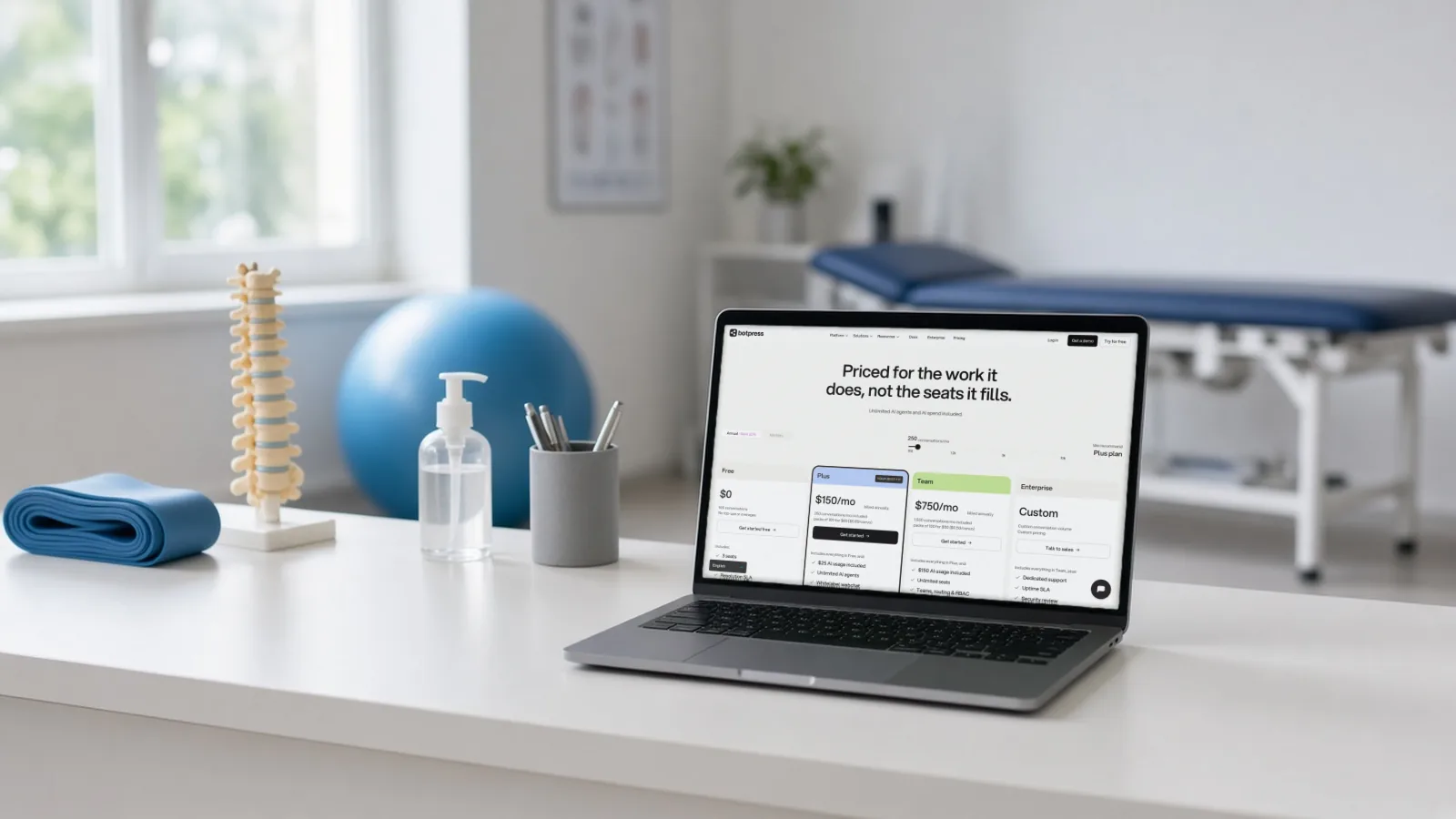
Botpress is the only tool here with a real monthly free AI tier, and it’s more of a builder than a plug-and-play widget.
- Free ($0): 100 conversations a month with no top-ups or overages, 3 seats, 3 AI agents, community support.
- Plus ($150 a month billed annually): 250 conversations a month, extra packs of 100 for $65 each ($0.65 per conversation), $25 of AI usage included, unlimited agents and white-label webchat.
- Team ($750 a month billed annually): 1,500 conversations, packs at $50 per 100, $150 of AI usage, unlimited seats and role-based access control.
- Enterprise: custom.
Botpress says every conversation includes $0.10 of AI usage, “covered by us”. At 95% of your quota a pack of 100 conversations is added automatically, and that auto-recharge can’t be turned off. Unused pack conversations expire at month end, and test conversations count. The annual price is shown as “Save 20%”, and the monthly price didn’t render, so it’s unconfirmed.
Pros and cons
These come from the makers’ pages, not from testing.
Tidio Lyro
- Pros: a lower-cost paid entry point; a free plan with a website scraper and FAQ upload; Lyro can be bought standalone for other helpdesks.
- Cons: the free 50 are one-off; monthly prices need confirming; lower regional prices make comparisons harder.
Intercom Fin
- Pros: you pay per outcome; a 14-day no-card trial; spending limits; standalone Fin for other helpdesks.
- Cons: at least one seat; the outcome rules conflict between pages; the cheap seat price is a new-customer promo.
Chatbase
- Pros: trains on your own content; many model providers; Calendly and WordPress listed on Hobby; flat credits.
- Cons: one agent per plan; branding removal is $1,188 a year; credits per model aren’t shown; the free plan is unclear.
Crisp (Hugo)
- Pros: a flat price with unlimited conversations; EU hosting; Hugo escalates rather than overspending by default.
- Cons: no AI on Free; Mini lacks AI Knowledge training in the table; white label only at $295.
Botpress
- Pros: a real monthly free tier; $0.10 of AI usage included per conversation; unlimited agents on Plus.
- Cons: a jump from $0 to $150 a month (billed yearly); packs added automatically; test chats count; more of a builder.
What 150 AI chats a month costs (our maths)
Scenario: a small clinic with one staff login and about 150 website chats a month handled by AI. These are list prices checked 28 October 2026, before tax, and our maths.
| Tool | Monthly billing | Yearly billing (per month) | Notes |
|---|---|---|---|
| Tidio | Free plan plus Lyro 150 = $110 (page data) | About $91.67 ($110 × 10/12) | Confirm monthly figures on the toggle |
| Intercom Fin | $29 seat (page data) plus up to 150 × $0.99 = up to $177.50 | $19 seat (promo) plus up to $148.50 = up to $167.50 | Only outcomes are charged; at Intercom’s default 76%, 114 × $0.99 = $112.86 plus the seat |
| Chatbase | Hobby $40 | $32 | Fits only if 150 chats use 700 credits or fewer; credits per model unconfirmed; extra $40 per 1,000 |
| Crisp | Mini $45 plus about 60 extra Hugo chats × $0.05 to $0.10 = about $48 to $51 (Pay-As-You-Go on) | Yearly price unconfirmed | Or Essentials $95 (about 450 AI chats, with knowledge training) |
| Botpress | Monthly price unconfirmed | Plus $150 (250 conversations) | Free covers only 100, and test chats count |
Print this next to it: a “chat” is counted differently by each tool, Crisp’s per-chat cost is Crisp’s own estimate, taxes and VAT are extra, and promos change. The cheapest real “AI on my website” for a tiny business is Botpress Free if you’ll build it yourself, or Tidio’s 50 to try. Crisp Mini and Chatbase Hobby are the low flat-rate paid options.
Who it's for
Which should you pick?
| If you are… | Start with | Why |
|---|---|---|
| A solo salon or tutor with a few chats | Tidio’s free 50 or Botpress Free | $0 to start; Botpress’s 100 repeat monthly |
| A 2 to 5 staff clinic with a person answering too | Tidio or Crisp Essentials | Handoff to humans; Crisp has 10 seats on Essentials |
| Already on Zendesk, HubSpot or similar | Fin standalone or Lyro standalone | Both can sit on top of another helpdesk |
| Holding lots of PDFs and documents to train on | Chatbase | Trains on your content; check the free plan at sign-up |
| On a tight budget with some tech confidence | Botpress | The real free tier, but you build the flow |
This is about fit, not tested rankings.
Setup checklist for any website chatbot
All five list a website widget. Crisp and Chatbase list WordPress. The install method on WordPress for Tidio, Intercom and Botpress is unconfirmed, so check their help pages.
- Write the FAQ page first: hours, prices, location, cancellation, what to bring.
- Add the widget code or plugin to your site.
- Set the hours when a human can take over.
- Set a “don’t answer” list: medical advice, refunds, anything legal.
- Test with 20 real questions, including the awkward ones.
- Share a booking link rather than letting the AI promise times.
Health and privacy (clinics, read this)
No tool here should give medical advice. Tell the bot to hand over to a person. On health data, the pages say:
- Intercom lists “HIPAA support” on the Expert plan ($132 per seat a month yearly, or $139 in page data).
- Chatbase lists “HIPAA-eligible” on Enterprise.
- Tidio lists “SOC 2 & HIPAA compliance” under its custom AI agent offer.
- Crisp and Botpress: unconfirmed.
Outside the US, check your local health-data rules before you put patient questions through any chatbot.
Outside the US?
- Prices on all five pages are in USD. Local currency display and taxes vary. Crisp adds VAT for EU consumers, EU businesses enter a VAT number, and no VAT is charged outside the EU. We haven’t confirmed the others’ tax handling.
- Regional pricing: Tidio’s page data holds lower regional prices for some markets. We don’t quote them. Check what the page shows you.
- Data location: Crisp is EU-hosted with a DPA, useful if your customers’ data needs to stay in the EU. Chatbase states GDPR compliance. We haven’t confirmed the others’ data locations.
- Languages: Tidio lists “Multilanguage” on Free in its page data, Chatbase claims 95+ languages (its own claim), Crisp’s Multilingual AI starts on Essentials, and Intercom’s multilingual help centre is on Advanced. Botpress is unconfirmed. We’ll test Spanish and one more language.
- Payment: we haven’t confirmed which payment methods each tool accepts in every location. Check that your payment method works before the trial ends.
Want it done for you?
If you’d rather not pick a billing model and wire it up, you can have AIFix set up an AI front desk on your website. AIFix is our own service. Its Automation page lists a Starter package with a $300 setup fee (checked live on 28 October 2026). It describes a front desk on WhatsApp, Instagram, Facebook and your website, answering from your prices, services and FAQs, with bookings going into your calendar. Read the page for what’s included, and don’t treat it as a quote.
For the WhatsApp side, see our WhatsApp AI chatbot guide. For phone calls, see our AI receptionist comparison, or our Retell vs Vapi vs Synthflow cost-per-minute comparison if you want to build a phone agent. If you want chat leads sent to a sheet or CRM, our n8n vs Make vs Zapier comparison covers the plumbing.
Alternatives
- WhatsApp instead of a website widget: see the WhatsApp guide.
- Phone: see the AI receptionist comparison.
- Tidio in depth: our Lyro review.
See how AIFix Automation handles this: AIFix Automation for website chat and enquiries.
FAQ
Is there a completely free AI chatbot for my website?
Partly. Botpress Free gives 100 conversations a month. Tidio gives 50 Lyro conversations once. Crisp’s Free plan has no AI. Chatbase’s free plan is unconfirmed: its pricing page didn’t show one on 28 October 2026.
Are Intercom and Fin different companies?
No. Fin is Intercom’s AI agent. You can use it with Intercom’s helpdesk, or on top of another helpdesk such as Zendesk, with $0.99 per outcome.
Can the chatbot book appointments?
Chatbase lists a Calendly integration on Hobby. For the others we haven’t confirmed. A safer pattern is that the AI answers, then shares your booking link.
Will it work on WordPress?
Crisp and Chatbase list WordPress. For Tidio, Intercom and Botpress, check the help pages.
Which AI model does each one use?
Tidio says Claude plus in-house models. Chatbase lets you pick from several providers. Intercom uses its own Fin Apex models. Crisp says the model selected affects the cost. Botpress covers the large-language-model cost up to $0.10 per conversation.
What happens when the AI doesn’t know?
Tidio, Intercom and Crisp document a handoff to a person. Crisp’s Hugo escalates to humans when it runs out of credits.
Sources
- Tidio pricing, Tidio (checked 28 Oct 2026)
- Tidio Lyro AI agent, Tidio (checked 28 Oct 2026)
- Intercom pricing, Intercom (checked 28 Oct 2026)
- Fin AI Agent pricing, Fin (Intercom) (checked 28 Oct 2026)
- Introducing Fin 4 (7 Oct 2026), Intercom Blog (checked 28 Oct 2026)
- Chatbase pricing, Chatbase (checked 28 Oct 2026)
- Chatbase llms.txt (older plan names; conflicts with the pricing page), Chatbase (checked 28 Oct 2026)
- Crisp pricing, Crisp (checked 28 Oct 2026)
- How does Hugo AI pricing and billing work?, Crisp Help (checked 28 Oct 2026)
- Botpress pricing, Botpress (checked 28 Oct 2026)
- AIFix Automation, AIFix (checked 28 Oct 2026)
This post was drafted with help from an AI assistant, then checked, edited and approved by Numan Malik.
Numan Malik, Founder, AIFix. Reviewed and approved by Numan before publishing. More about Numan · Editorial policy