YouTube Music AI Label: Songs Made Mainly With AI Now Get a Tag. What Creators Need to Know
From 14 Oct 2026 the YouTube Music AI label shows on the player when a song was made primarily with generative AI. How YouTube decides, the Fully, Partly and No Gen AI choices with YouTube's own examples, how partners declare it, and what YouTube hasn't said.

Research-based overview: we have not tested this hands-on yet, so there is no score. Facts come from the makers' own pages, linked below.
On this page
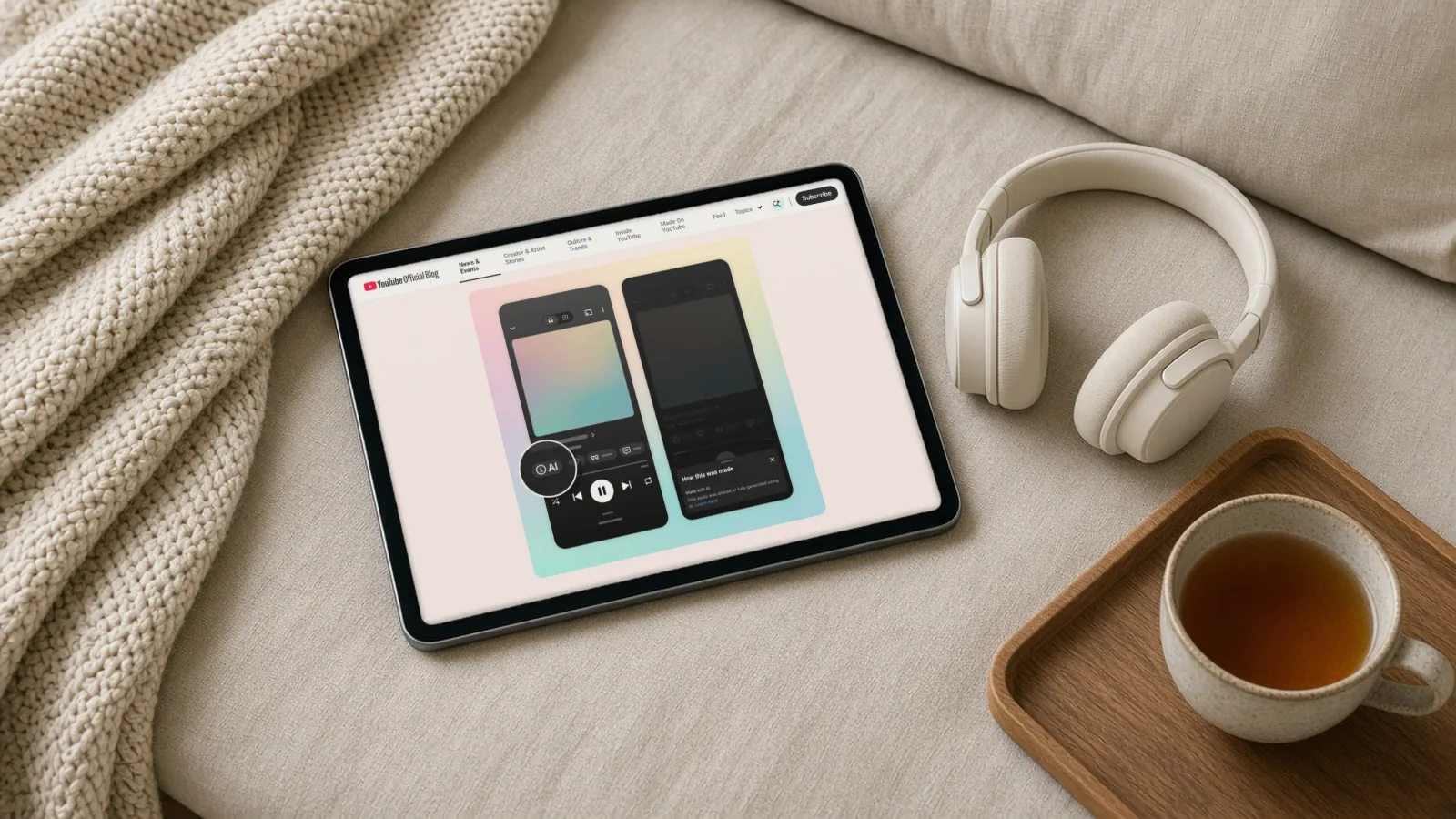
Key takeaway: The new YouTube Music AI label appears on the player page when a song “was created primarily using generative AI”, for example when an AI model made the composition and vocals. YouTube started rolling it out on 14 October 2026 and says it will reach the main YouTube app too, with no date given. YouTube decides using music partners’ declarations plus its own detection tools. It hasn’t said anything about reach, monetisation or royalties.
- Where you’ll see it: directly on the YouTube Music player page; tapping the label opens a short menu with more information. (YouTube blog)
- Three choices for partners: Fully Gen AI, Partly Gen AI or No Gen AI. (YouTube Help)
- Cost: none. It’s a platform policy, and declaring is free.
Research-based news. Facts come from YouTube’s blog post and help page, checked 22 October 2026. We haven’t uploaded a test track.
What YouTube announced
On 14 October 2026 YouTube said listeners “want transparency when they’re hearing an AI-generated track”. YouTube Music “is rolling out labels” for songs made primarily with generative AI, shown “directly on the player page”. The labels “will also expand to the main YouTube app”. YouTube is “teaming up with music partners and using our own detection tools”, applying the same labelling principles it uses across YouTube.
How YouTube decides on a YouTube Music AI label
The help page is written for music partners: record labels, distributors and Content Manager users. Partners “should disclose” generative AI use. YouTube “may use additional signals” too. If a partner gives no information, YouTube relies on those signals and “may designate content as fully or partly Gen AI”. With no value, YouTube treats a track as unknown unless other signals decide. (YouTube Help)
Fully, Partly or No Gen AI: YouTube’s own examples
| Designation | YouTube’s examples |
|---|---|
| Fully Gen AI | Typing a text prompt into an AI music generator and downloading the track. An artist generating the composition, instrumental performance and vocals with AI, even after several refining prompts. |
| Partly Gen AI | AI-generated layers “(e.g., a bassline or string section)” with the artist’s own live vocals and instruments on top. AI help brainstorming lyrics or melodies, then recording in the studio. A song with 100% human-performed audio but an AI-generated music video. |
| No Gen AI | Standard pitch correction “(e.g., Auto-Tune)” for minor tuning mistakes. Automated AI mastering software for the final EQ, compression and balance. |
YouTube adds that “it is up to partners to interpret the Gen AI definitions provided by DDEX” (the music industry’s metadata standard).
Three cases that surprise people
- Auto-Tune on a live vocal counts as No Gen AI.
- AI mastering counts as No Gen AI.
- A fully human song with an AI-made music video counts as Partly Gen AI.
How to declare it
- DDEX ERN 4.3.2 or later, the delivery format labels and distributors use.
- CSV templates in Content Manager (Studio Content Manager > Content updates > Templates). The
contains_aicolumn takes all, partly, none or unknown; “unknown” clears a wrong declaration. - YouTube Studio: partners who upload there “can mark disclosures in the attribute section”.
Not every channel will see these exact fields; they’re described for music partners.
What YouTube hasn’t said
These points are unconfirmed; YouTube’s pages don’t mention them:
- Whether Partly Gen AI songs get a visible label. The blog only talks about songs made “primarily” with AI.
- Any effect on recommendations, reach, monetisation or royalties.
- Whether music distributors pass an independent artist’s AI declaration to YouTube. Ask yours.
A simple checklist for creators
Our advice, not YouTube’s rules:
- Keep notes on which tool made which part of each song, including the video.
- Declare accurately, using YouTube’s examples as your guide.
- Ask your distributor how they send the AI declaration to YouTube.
- Check old releases with AI-made videos; they may count as Partly Gen AI.
Want your weekly clips handled while you focus on the music? AIFix Autopilot does weekly clipping and posting for creators; it’s our own service.
What we checked, and what we’ll test
On 22 October 2026 we read YouTube’s 14 October blog post and the help article “Disclose Gen AI usage for music content”. We haven’t seen a label on a live track ourselves yet. We’ll add an “Updated” line when labels reach the main YouTube app.
FAQ
What is the YouTube Music AI label?
A label on the YouTube Music player page for songs made primarily with generative AI. Tap it for more details.
Will Auto-Tune get my song labelled as AI?
Not according to YouTube’s examples. Standard pitch correction for minor tuning mistakes counts as No Gen AI.
Does the label affect monetisation?
YouTube hasn’t said. Its blog post and help page don’t mention money, reach or royalties.
I’m an independent artist. How do I declare AI use?
The help page is for music partners. If a distributor delivers your music, ask them how they pass on your declaration.
Sources
- YouTube Music adds new labels for AI music (14 Oct 2026), YouTube Official Blog, 2026 (checked 22 Oct 2026)
- Disclose Gen AI usage for music content, YouTube Help (checked 22 Oct 2026)
- Autopilot, AIFix (checked 23 Oct 2026)
This post was drafted with help from an AI assistant, then checked, edited and approved by Numan Malik.
Numan Malik, Founder, AIFix. Reviewed and approved by Numan before publishing. More about Numan · Editorial policy