Kimi K3.1 Pro vs DeepSeek V4.1 vs Claude Opus 5.5: Open Models vs Paid, Prices and Benchmarks
Kimi K3.1 Pro, DeepSeek V4.1 Flash and Claude Opus 5.5 compared on API price, context, open weights, licence and each vendor's own benchmarks, with a worked monthly cost. Checked 30 Oct 2026; research-based.

No one paid for this, and it has no affiliate links. How we review.
Research-based overview: we have not tested this hands-on yet, so there is no score. Facts come from the makers' own pages, linked below.
On this page
Three big AI models are on the table this week, and they sit at very different price points. Kimi K3.1 Pro from Moonshot AI is new and promises open weights. DeepSeek V4.1 Flash already has open weights under the MIT licence and is the cheapest by a wide margin. Claude Opus 5.5 from Anthropic is closed and costs the most per token. This page lines them up on what each company publishes, so you can pick one for a job without reading three launch posts. For the launch details of Kimi alone, see our Kimi K3.1 Pro pricing and specs post.
“Open weights” means the company publishes the model files, so you or a hosting company can run the model on your own servers. “Context window” is how much text the model can hold in one go; 1 million tokens is roughly a few thick books.
Key takeaways
Verdict in one minute
- Cheapest by far: DeepSeek V4.1 Flash. Off-peak list prices are $0.15 per million input tokens and $0.60 per million output tokens, and the weights are already out under MIT.
- Middle price, newest: Kimi K3.1 Pro. $2 in and $10 out. Moonshot’s own coding scores sit close to Opus 5.5’s, but the weights aren’t public yet (promised by 4 November 2026).
- Most expensive, most complete product: Claude Opus 5.5. $4 in and $20 out on the API, and it’s also inside the paid Claude apps and Claude Code.
- Kimi vs DeepSeek in one line: Kimi reports higher agent and coding scores; DeepSeek is roughly 13 to 17 times cheaper per token off-peak and is open today.
- Kimi K3.1 Pro vs Opus 5.5 in one line: on the one benchmark both publish, the scores are within a point of each other, and Kimi’s list price is half of Opus’s.
Research-based comparison. We haven’t run these three models side by side ourselves. Everything here comes from the vendors’ own pages, read on 30 October 2026. Benchmark numbers are what each company reports about its own model. Prices are USD, before tax.
At a glance: Kimi K3.1 Pro vs DeepSeek V4.1 Flash vs Claude Opus 5.5 (USD, list prices)
| Tool | API price, input / output per 1M tokens | Context window | Open weights and licence | Terminal-Bench 4.0 (vendor-reported) |
|---|---|---|---|---|
| Kimi K3.1 Pro (Moonshot AI) | $2 / $10 (cached input $0.20) | 1,048,576 tokens | Promised by 4 Nov 2026; not public on 30 Oct. Licence unconfirmed | 65.7% |
| DeepSeek V4.1 Flash | $0.15 / $0.60 off-peak; double at peak (cached input $0.003 off-peak) | 1M tokens, up to 384K output | Yes, MIT licence, on Hugging Face | 42.3 |
| Claude Opus 5.5 (Anthropic) | $4 / $20 (cache read $0.20); Batch 50% off | 1M tokens, up to 128K output | No, closed model | 66.4% |
What we checked
- Read Moonshot's Kimi K3.1 Pro blog, quickstart and API pricing page on 30 Oct 2026
- Checked the Kimi K3.1 Pro open-weights repo on Hugging Face on 30 Oct 2026 (not public yet)
- Read DeepSeek's V4.1 Flash release note, pricing page and model card on 30 Oct 2026
- Read Anthropic's Claude Opus 5.5 announcement, models overview and Claude pricing page on 30 Oct 2026
- Worked out one monthly API bill from list prices (our arithmetic)
- Not done yet: running the same tasks through all three models
The three models in plain words
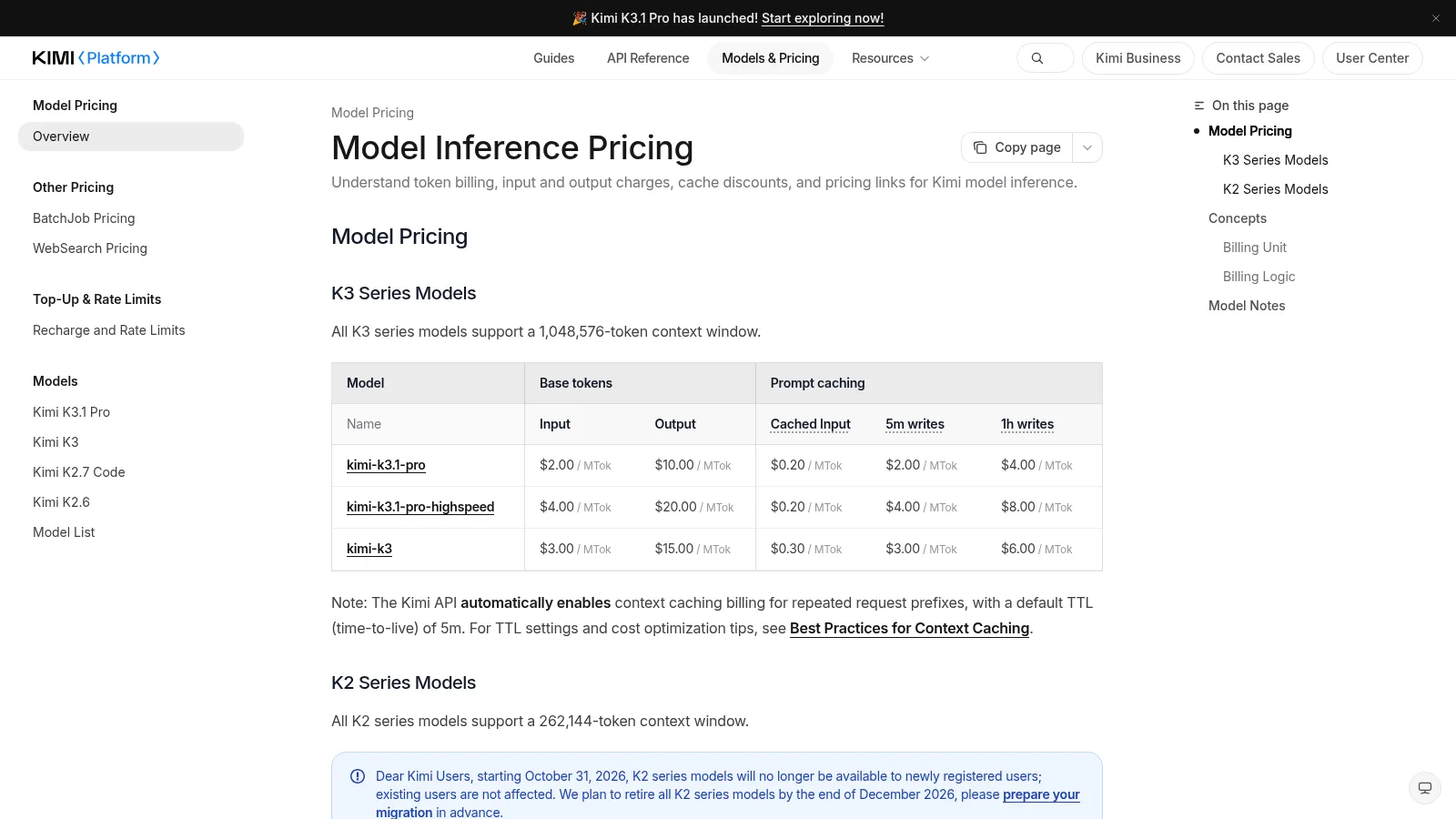
Kimi K3.1 Pro is Moonshot AI’s newest model. The API pricing page lists it at $2 per million input tokens and $10 per million output tokens, with cached input (text you send again and again, like a long system prompt) at $0.20. A faster “highspeed” version costs $4 in and $20 out, and Moonshot says it runs 2 to 3 times faster. The context window is 1,048,576 tokens. Moonshot says API customers get Zero Data Retention, meaning it doesn’t keep your prompts. Older K2 models stop taking new users on 31 October 2026.
DeepSeek V4.1 Flash (the 1017 release, called deepseek-flash in the API) is a 763.2-billion-parameter open-weights model under the MIT licence, one of the most permissive licences there is. It has a 1M-token context, up to 384K tokens of output and image input. DeepSeek also lists V4 Pro (the 0813 release) at $0.66 in and $1.98 out off-peak, if you want its bigger model. DeepSeek’s API also accepts the Anthropic API format, so tools built for Claude can often be pointed at it.
Claude Opus 5.5 is Anthropic’s top model, launched on 22 September 2026. It has a 1M-token context and up to 128K tokens of output. On the API it costs $4 in and $20 out, with cache reads at $0.20 and cache writes at $5. A fast mode costs $8 in and $40 out, and the Batch API halves the price for jobs that can wait.
Pricing compared
| Input per 1M tokens | Output per 1M tokens | Cached input | Notes | |
|---|---|---|---|---|
| Kimi K3.1 Pro | $2 | $10 | $0.20 | Cache writes $2 (5 minutes) or $4 (1 hour) |
| Kimi K3.1 Pro highspeed | $4 | $20 | $0.20 | Moonshot says 2 to 3 times faster |
| DeepSeek V4.1 Flash, off-peak | $0.15 | $0.60 | $0.003 | Peak hours cost double |
| DeepSeek V4 Pro, off-peak | $0.66 | $1.98 | $0.022 | Peak hours cost double |
| Claude Opus 5.5 | $4 | $20 | $0.20 (cache read) | Cache write $5; Batch 50% off; fast mode $8 / $40 |
All prices checked 30 Oct 2026. DeepSeek’s peak hours are 01:00 to 04:00 and 06:00 to 10:00 UTC, Monday to Friday. If your app runs mostly in those hours, use the doubled price for budgeting.
A worked monthly bill
Say your app sends 10 million input tokens and gets back 2 million output tokens a month, with no caching. Our arithmetic from list prices:
| Model | Sum | Monthly cost |
|---|---|---|
| DeepSeek V4.1 Flash, off-peak | 10 × $0.15 + 2 × $0.60 | $2.70 |
| DeepSeek V4.1 Flash, all at peak | double the above | $5.40 |
| Kimi K3.1 Pro | 10 × $2 + 2 × $10 | $40 |
| Claude Opus 5.5 | 10 × $4 + 2 × $20 | $80 |
| Claude Opus 5.5 via Batch | half of the above | $40 |
Caching changes these numbers a lot if you resend the same long prompt. Real bills also depend on how many tokens each model uses to “think”, which we haven’t measured.
Benchmarks: what each company reports
Terminal-Bench 4.0 is the only test all three companies publish a score for. It measures how well a model completes tasks in a computer terminal, which is close to real coding-agent work.
| Model | Terminal-Bench 4.0 | Other scores the vendor highlights |
|---|---|---|
| Claude Opus 5.5 | 66.4% | Anthropic publishes several more in its announcement |
| Kimi K3.1 Pro | 65.7% | BenchCAD 92.7%, OfficeQA Pro v2 64.4, Kimi Code Bench 61.2%; hallucination rate on Hallu Bench Hard down from 23.4% to 8.3% |
| DeepSeek V4.1 Flash | 42.3 | DeepSWE 77.0, Humanity’s Last Exam without tools 42.6 |
Each company ran its own test with its own settings, so a one-point gap means very little. What the table does show is that Moonshot claims Opus-class coding scores at half the price, and that DeepSeek’s cheaper model reports a clearly lower terminal score. Moonshot also says its model is behind the best closed models on cyber-security tasks.
Open weights and licence
- DeepSeek V4.1 Flash: weights are on Hugging Face now, under MIT. You can run it yourself, fine-tune it and use it commercially. At 763.2 billion parameters, running it yourself needs serious server hardware, so most small teams will still use the API or a hosting company.
- Kimi K3.1 Pro: Moonshot says the weights come “by Nov 4, 2026”. On 30 October the repo wasn’t public. The earlier Kimi K3 uses a custom licence named “kimi-k3”, so check the K3.1 licence terms when they appear. Until then, the K3.1 licence is unconfirmed.
- Claude Opus 5.5: no weights. You use it through Anthropic’s apps and API.
Where you can use each one
- Kimi K3.1 Pro: the Kimi API platform (model name
kimi-k3.1-pro). Moonshot also runs the Kimi chat app, but we didn’t confirm which app plans include K3.1 Pro or their limits. - DeepSeek V4.1 Flash: the DeepSeek API, or your own servers using the open weights. We didn’t confirm what the free chat app runs or its limits.
- Claude Opus 5.5: the API, plus the Claude apps on paid plans. Claude’s Free plan doesn’t include Opus or Claude Code. Pro is $20 a month ($17 a month billed yearly) and includes both; Max starts at $100 a month.
What we checked, and what we haven’t tested
We read each vendor’s launch post, pricing page and model documentation, and checked the open-weights repos on 30 October 2026. We haven’t sent the same tasks to all three models, so we can’t say which writes better code for you, follows instructions better or stays on track longer. When we do, the plan is one short coding task, one long-document question and one tool-calling task per model, logging tokens used and cost.
Pros and cons
| Pros | Cons | |
|---|---|---|
| Kimi K3.1 Pro | Strong vendor-reported coding scores; half Opus’s price; 1M context; weights promised | Weights and licence not out yet; Moonshot says it trails on cyber tasks |
| DeepSeek V4.1 Flash | Very low price; MIT weights available now; accepts the Anthropic API format | Peak-hour price doubles; lower vendor-reported terminal score; very large to self-host |
| Claude Opus 5.5 | Highest vendor-reported terminal score here; full app and Claude Code product | Highest token price; closed; no Opus on the free plan |
Who it's for
Which should you pick?
- You’re building a high-volume feature such as tagging support tickets, summarising documents or sorting leads: start with DeepSeek V4.1 Flash. At these prices you can test a lot for a few dollars.
- You need a model you can host yourself for privacy or control: DeepSeek V4.1 Flash today. Wait for the Kimi K3.1 Pro weights and licence if you want a second option.
- You run coding agents or long tool-calling tasks on a budget: try Kimi K3.1 Pro. Its vendor-reported scores are near Opus’s at half the price.
- You want one finished product for chat, documents and coding and don’t want to manage APIs: Claude Opus 5.5 through a Claude Pro plan.
- You’re unsure: run the same ten real tasks from your work through each API and compare cost and quality. That tells you more than any benchmark.
If you’re choosing a general assistant rather than an API model, our ChatGPT vs Claude vs Gemini comparison covers the apps and their free plans.
FAQ
Is Kimi K3.1 Pro better than Claude Opus 5.5?
On Terminal-Bench 4.0, the two companies report 65.7% and 66.4%, which is too close to call given different test setups. Kimi’s list price is half of Opus’s. We haven’t compared them on real tasks.
Kimi vs DeepSeek: which is cheaper?
DeepSeek V4.1 Flash. Off-peak it’s $0.15 in and $0.60 out per million tokens, against Kimi K3.1 Pro’s $2 and $10. Even at DeepSeek’s doubled peak price, it’s still several times cheaper.
Is Kimi K3.1 Pro open source?
Not yet. Moonshot promises open weights by 4 November 2026, and the licence wasn’t published when we checked on 30 October.
Can I run DeepSeek V4.1 Flash on my own computer?
The weights are public under MIT, but at 763.2 billion parameters it needs data-centre hardware, not a laptop. Most teams use the API or a hosting provider.
Is Claude Opus 5.5 free?
No. Claude’s Free plan doesn’t include Opus. You need a paid Claude plan (Pro from $20 a month) or API credit.
Do these prices include tax?
No. They’re list prices in USD, before tax, read on 30 October 2026.
Related reading
Sources
- Kimi K3.1 Pro tech blog: Advancing Open Intelligence, Moonshot AI (Kimi) (checked 30 Oct 2026)
- Model inference pricing, Kimi API platform (checked 30 Oct 2026)
- Kimi K3.1 Pro quickstart, Kimi API platform (checked 30 Oct 2026)
- Kimi K3 model card (licence), Hugging Face (checked 30 Oct 2026)
- DeepSeek V4.1 Flash release note, DeepSeek API Docs (checked 30 Oct 2026)
- Models and pricing, DeepSeek API Docs (checked 30 Oct 2026)
- DeepSeek-V4.1-Flash-1017 model card, Hugging Face (checked 30 Oct 2026)
- Introducing Claude Opus 5.5, Anthropic (checked 30 Oct 2026)
- Models overview, Claude Docs (checked 30 Oct 2026)
- Claude pricing, Anthropic (checked 30 Oct 2026)
This post was drafted with help from an AI assistant, then checked, edited and approved by Numan Malik.
Numan Malik, Founder, AIFix. Reviewed and approved by Numan before publishing. More about Numan · Editorial policy