Anthropic's Reported $3.4B Gas Deal: Why AI Data Centers Are Building Their Own Power
Anthropic has reportedly agreed a deal worth about $3.4 billion (USD) for 1.7 GW of gas-fired generators, the FT reported on 8 Nov 2026. What Reuters and Bloomberg say, what isn't known yet, and why AI data centers are turning to on-site power.

Research-based overview: we have not tested this hands-on yet, so there is no score. Facts come from the makers' own pages, linked below.
On this page
Key takeaway: Anthropic has reportedly agreed a deal worth about $3.4 billion (USD) for 1.7 gigawatts (GW) of gas-fired generators to power its data centres. The Financial Times reported the deal on 8 November 2026, and Reuters and Bloomberg followed. Anthropic hasn’t confirmed it publicly. The story is part of a wider shift: AI data centers are adding their own power on site because grid connections are slow.
Reported news. Deal details come from the FT, as reported by Reuters and Bloomberg on 8 November 2026. Reuters said it could not immediately verify the report. Context figures come from the International Energy Agency (IEA). Checked 10 November 2026.
What was reported
According to Reuters, citing the FT:
- Anthropic struck a deal worth about $3.4 billion to secure gas-fired power generators for data centres.
- In late September it bought commitments for 1.7 GW of heavy-duty generators from OnePWR Solutions, an equipment supplier based in San Antonio, Texas.
- Anthropic did not acquire OnePWR, and none of the supplier’s staff moved to Anthropic. The FT said the deal included the engineering and construction capabilities needed to install the generators, citing a person familiar with the matter.
Bloomberg added more detail from the FT report:
- The FT described it as the largest known single purchase of power-generation equipment by an AI lab.
- Anthropic first planned to buy power from OnePWR. It then took over OnePWR’s Caterpillar generator orders instead.
- Bloomberg called the purchase “the latest sign of AI labs pushing deeper into the energy industry and bypassing intermediaries in the race to secure scarce power equipment”.
Reuters said Anthropic and OnePWR did not respond to its requests for comment.
What we don’t know yet
The reports we read don’t say:
- which data centre sites the generators will power;
- when they will be delivered or running;
- how the $3.4 billion splits between equipment and installation.
We’ll update this post if Anthropic or OnePWR confirms details.
Why AI data centers are building their own power
The short answer is time. Data centres need a lot of electricity, and the grid can’t connect them fast enough.
The IEA’s April 2026 report, Key Questions on Energy and AI, gives the scale:
- Demand is rising fast. Data centre electricity use grew 17% in 2025. Use by AI-focused data centres grew 50%.
- It may double by 2030. The IEA projects data centre use rising from 485 terawatt-hours (TWh) in 2025 to 950 TWh in 2030, about 3% of global electricity demand.
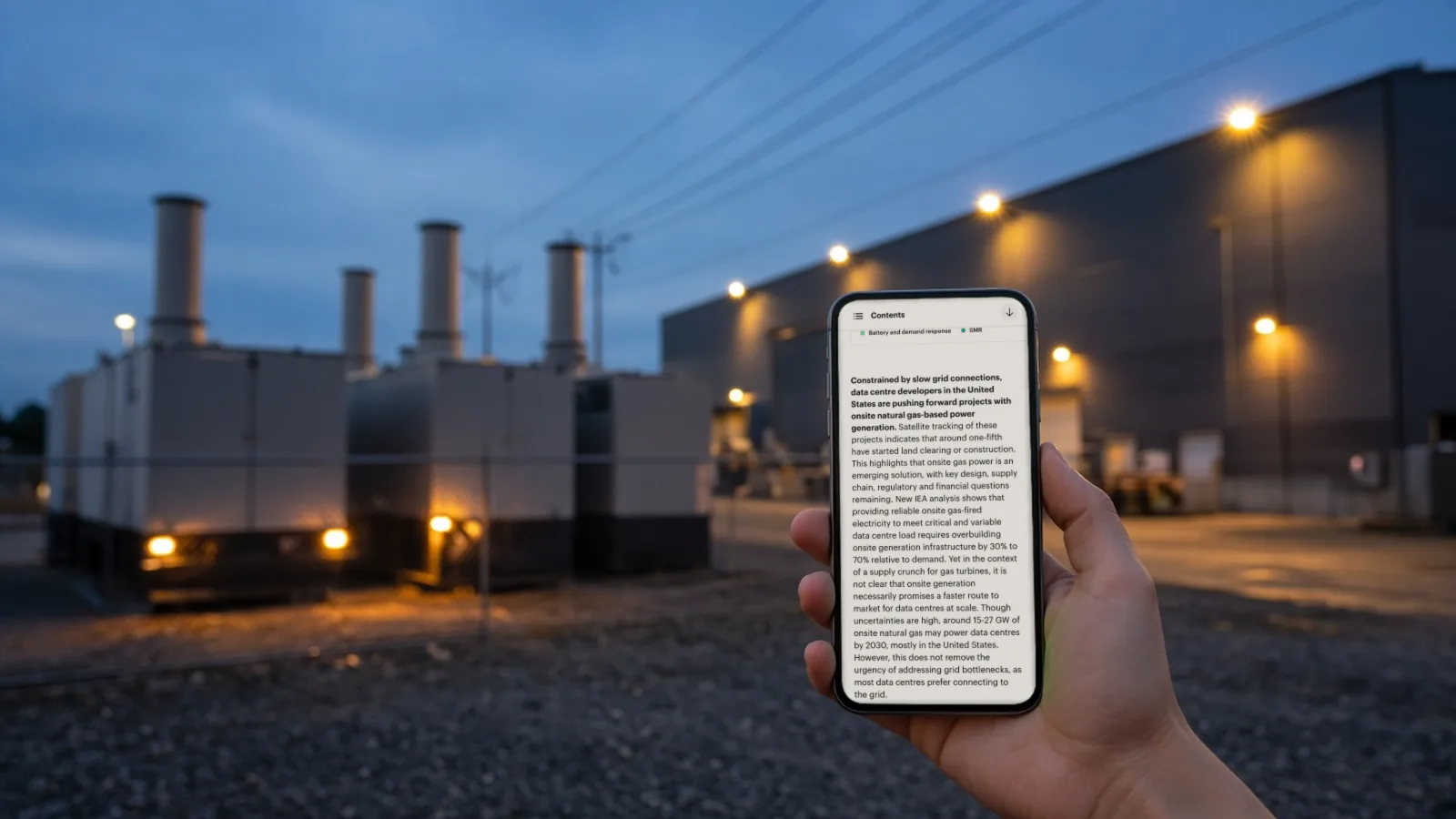
- On-site gas is growing. Because grid connections are slow, developers are pushing ahead with on-site gas power, mostly in the United States. The IEA estimates 15 to 27 GW of on-site gas may power data centres by 2030.
- Equipment is scarce. The IEA says gas turbine orders surged 70% in 2025, highlighting “chokepoints” in supply chains.
The IEA’s earlier Energy and AI report explains the delays. New transmission lines can take four to eight years in advanced economies. Turbines for new gas plants face lead times of several years. It estimated that around 20% of planned data centre projects could be delayed unless grid risks are addressed.
Our maths: 1.7 GW is roughly 6% to 11% of the IEA’s 15–27 GW range for on-site gas at data centres by 2030. That’s why a single deal of this size stands out.
The catch with on-site gas
The IEA doesn’t present on-site gas as an easy fix:
- It needs extra capacity. AI data centres have rapid, large swings in demand. The IEA says reliable on-site gas power needs 30% to 70% more generation than the load it serves.
- It may not be faster. With turbines in short supply, the IEA says “it is not clear that onsite generation necessarily promises a faster route to market for data centres at scale”.
- Batteries are becoming part of the design. The IEA says around 20–25 GW of battery storage could be installed at data centres worldwide by 2030.
- Most still want the grid. The IEA notes that most data centres prefer a grid connection.
Emissions matter too. The IEA projects data centre emissions reaching around 350 million tonnes by 2035, about 2% of global electricity sector emissions.
Why it matters if you use AI tools
You don’t need to do anything because of this deal. But power is now one of the limits on how much AI capacity exists. When a lab struggles to get compute, it can show up as usage limits, waitlists or slower rollouts. When capacity grows, those limits can ease.
Two points from the IEA help keep this in proportion:
- Energy use per AI task is falling fast. The IEA says simple text queries now typically use less electricity than running a television for the same time.
- Heavier tasks, such as video generation, reasoning and AI agents, can use hundreds or thousands of times more energy per query than simple text.
For a small business or creator, the practical step is simple. Use the lightest tool that does the job well, and save heavy models for the tasks that need them.
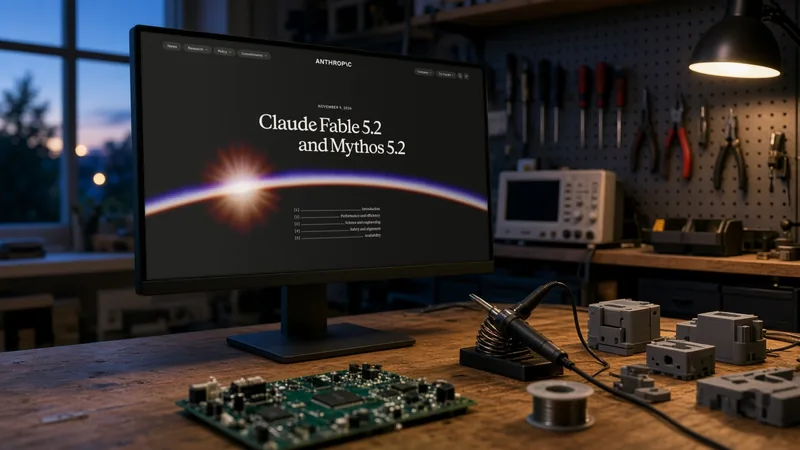
Bloomberg also reports that Anthropic said it intends to spend more than $895 billion in the years ahead, mostly on computing power and infrastructure. For more on Anthropic’s filing and plans, see our post on Anthropic’s S-1 filing. For its newest models, see Claude Fable 5.2 and Mythos 5.2.
Make the AI you already use count
Whatever happens to AI capacity, the tools work best when they’re tied to real tasks. AIFix Automation can set up AI assistants that answer, book and remind, with your approval or on rules you set, on accounts in your name. That’s our own service.
FAQ
What is Anthropic’s gas deal?
The FT reported on 8 November 2026 that Anthropic agreed a deal worth about $3.4 billion for 1.7 GW of gas-fired generators to power its data centres. Reuters and Bloomberg reported the FT story. Anthropic hasn’t confirmed it publicly.
Who is OnePWR?
According to Reuters, OnePWR Solutions is an equipment supplier based in San Antonio, Texas. Anthropic reportedly took over its Caterpillar generator orders but did not buy the company.
Why are AI data centers building their own power?
Grid connections and new power lines can take years. The IEA says developers are turning to on-site gas, mostly in the US, though turbine shortages mean it isn’t always faster.
How much electricity do AI data centers use?
The IEA says data centres used about 485 TWh in 2025 and could reach about 950 TWh by 2030, around 3% of global electricity demand.
Will this change Claude’s prices or limits?
Nothing has been announced. Anthropic hasn’t commented on the deal, so any link to prices or usage limits would be speculation.
Sources
- Anthropic strikes $3.4bn deal to generate gas-fired power for data centres, Financial Times, 2026 (checked 10 Nov 2026)
- Anthropic secures $3.4 billion generator deal for AI data centers, FT reports, Reuters, 2026 (checked 10 Nov 2026)
- Anthropic Buys Power for AI Data Centres in $3.4B Deal, FT Says, Bloomberg, 2026 (checked 10 Nov 2026)
- Key Questions on Energy and AI: Executive summary, IEA, 2026 (checked 10 Nov 2026)
- Data centre electricity use surged in 2025, even with tightening bottlenecks driving a scramble for solutions, IEA, 2026 (checked 10 Nov 2026)
- Energy and AI: Executive summary, IEA, 2025 (checked 10 Nov 2026)
- AIFix Automation, AIFix (checked 10 Nov 2026)
This post was drafted with help from an AI assistant, then checked, edited and approved by Numan Malik.
Numan Malik, Founder, AIFix. Reviewed and approved by Numan before publishing. More about Numan · Editorial policy