Amazon Blocks Meta Muse: What the AI Shopping Agent Fight Means for Small Online Stores
Amazon blocked Meta's Muse shopping agent in September and its CEO doubled down on 29 October. What happened, what each side says, and a short checklist for small online stores deciding whether to let AI shopping agents in. Checked 2 Nov 2026; research-based.

Research-based overview: we have not tested this hands-on yet, so there is no score. Facts come from the makers' own pages, linked below.
On this page
Amazon blocked Meta’s Muse shopping agent from its store in September. On 29 October, Amazon’s CEO Andy Jassy explained why the company isn’t worried about agents like it. The story is back in the news this week, and it raises a practical question for anyone who runs a small online store: should you let AI shopping agents buy from you, and how would you even know they’re there?
Quick terms. An AI shopping agent is an assistant that can search for products, fill a cart and check out for someone. Muse is Meta’s personal AI agent, launched on 8 September 2026. A bot is any automated visitor to your site, from search crawlers to scrapers.
What happened
According to GeekWire and The Verge, Amazon started blocking Muse on the evening of Sunday 20 September 2026. Muse users who tried to shop Amazon saw a popup that read: “Continued access by an unauthorized AI agent violates Amazon’s Conditions of Use, to which our customers have agreed.”
An Amazon spokesperson told reporters: “We think it’s fairly straightforward that third-party applications that offer to make purchases on behalf of customers from other businesses should operate openly and respect service provider decisions about whether or not to participate.” Amazon also said it had asked Meta to remove Amazon from the Muse experience.
Amazon’s complaint, as reported, is that Muse doesn’t identify itself when it visits, and that it appears to capture customers’ login details. Meta’s launch materials say Muse “has no visibility into people’s passwords or payment methods”, and that Muse asks the user before it makes a purchase. Meta hadn’t publicly commented on the block at the time of writing (2 November 2026); GeekWire and Bloomberg reported that Meta didn’t respond to requests for comment.
What Amazon’s rules actually say
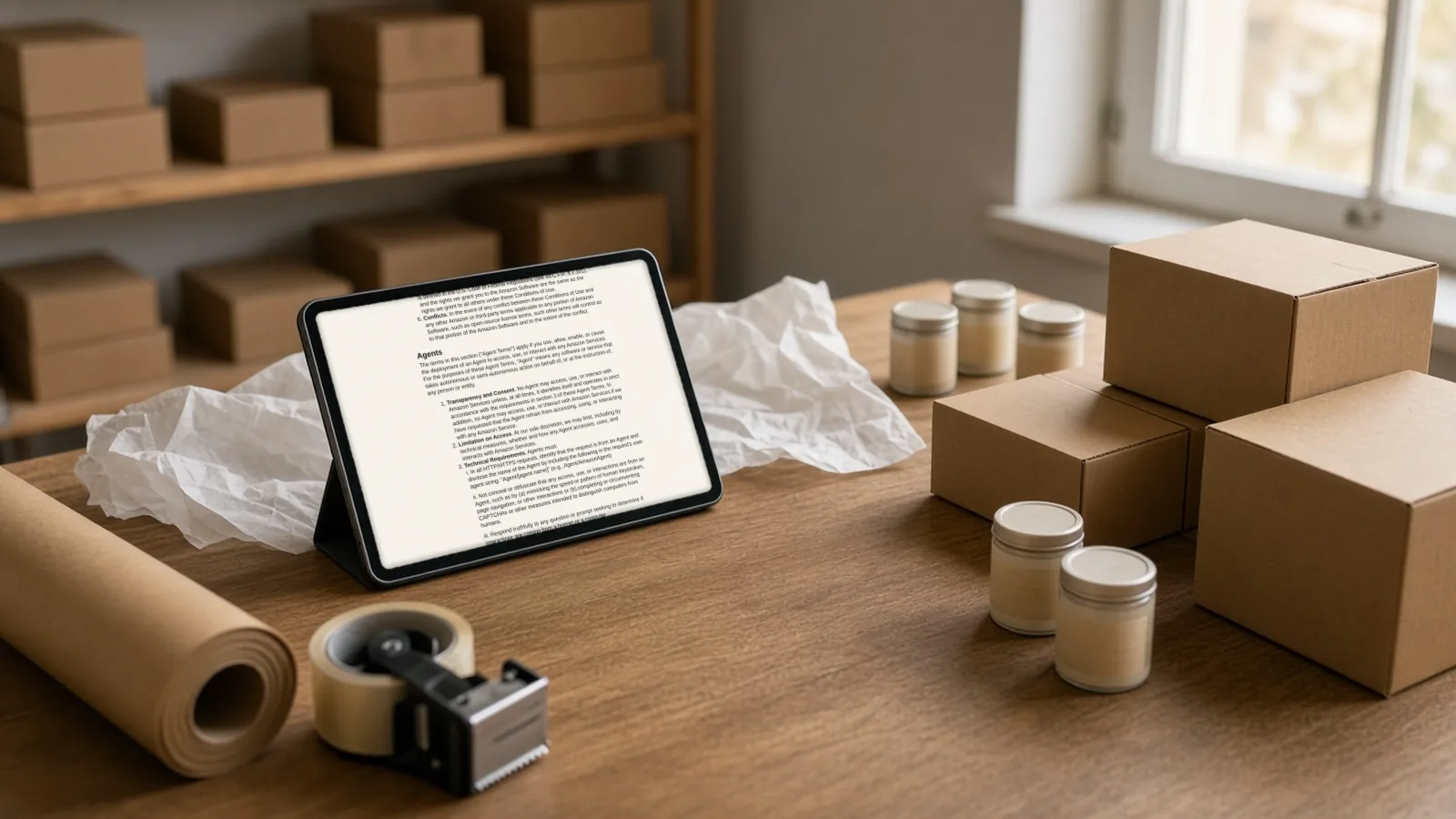
The block rests on the Agents section of Amazon’s Conditions of Use, last updated 14 August 2026. We read it on 2 November. In short:
- Agents must identify themselves as agents.
- The agent’s user-agent string (the name a visitor’s software sends with every request) must include “Agent/[agent name]”.
- Agents must not mimic human keystrokes or get around CAPTCHAs.
- Amazon may ask an agent to stop accessing its store.
That’s the core of the dispute. Amazon isn’t saying agents can never shop there. It’s saying agents must announce themselves, and that Amazon gets to decide whether to let them in.
What Jassy said on 29 October
On Amazon’s third-quarter earnings call, Jassy took a question on whether outside agents are hurting Amazon’s ad business:
“The natural question is whether agentic shopping from external horizontal agents is meaningfully impacting Amazon Ads. The answer is no. Few customers are doing much shopping this way yet, as the experience is still not great nor more convenient than coming to a retailer directly to research or one-click order there.”
He added: “Though we anticipate working with horizontal agents, we believe Alexa for Shopping is going to be the primary shopping agent customers use to shop Amazon.”
So Amazon’s position is twofold. Outside agents must follow its rules, and its own agent is the one it wants shoppers to use.
Not every retailer is closing the door
Meta’s own Connect 2026 recap (24 September) lists the stores it’s working with. Muse launched with access to the entire Shopify catalogue. Meta then added Walmart, Best Buy, American Eagle Outfitters, DICK’S Sporting Goods, Fanatics, Gap, Michael Kors, Sephora, Ulta and Wayfair, plus Shop Pay and PayPal for payments.
Walmart has gone further and published its own rules. On 21 October it announced three things:
- Agent Profiles, “launching in the next month”. Each agent gets its own profile inside the customer’s account. Customers can approve every purchase, or set a spending limit such as $50, $100 or $200.
- The Walmart Agent Gateway, a faster route for agents built on MCP (a common standard for connecting AI tools to services). It starts as a beta for companies and developers.
- Terms for AI agents. Customers approve purchases by default, agents don’t receive card details, and agents that don’t comply will be blocked.
Walmart also said: “We price products, not people”, meaning an agent sees the same prices a person would.
Put the two side by side and you get the real lesson. Amazon and Walmart both want agents to be identified and to follow rules. They differ on whether to let outside agents in today.
What this means for small online stores
Most small stores aren’t Amazon. You may want the extra sales an agent can bring, and you probably don’t have a team watching bot traffic. Here’s what’s worth knowing.
If you sell on Shopify, you may already be in. Shopify’s “Selling on Meta” help page, read on 2 November, says direct checkout through Meta AI and Muse is on by default for eligible stores in eligible regions. Per that page:
- There are no extra fees for Meta’s direct checkout. You pay only your standard payment processing fees.
- You stay the merchant of record, so the order, refunds and customer service are yours.
- Third-party tracking pixels don’t fire on those checkouts.
To opt out, Shopify’s page gives this path: Sales channels > Agentic, turn off Allow Shopify to manage for me, then under Meta AI and Muse change Shopify Catalog access or Direct checkout, and Save. Shopify also notes that turning off catalog access doesn’t stop AI tools from crawling your public pages; that’s covered on a separate Shopify help page about hiding products from AI channels.
Agents are starting to sign their requests. A proposed standard called Web Bot Auth lets a bot sign each request so a site can check who sent it. Google’s documentation describes it as experimental and based on an IETF draft, and Cloudflare can verify bots that use it. Meta hasn’t said whether Muse signs its requests this way.
Your old bot rules may be making the choice for you. If your firewall or bot-protection tool blocks unknown automated visitors, it may already be stopping some agents, or letting some in, without anyone deciding. It’s worth a look either way.
A five-step checklist
- Decide your policy. Do you want agent orders? If yes, which ones, and with what limits?
- Check your platform settings. On Shopify, open Sales channels > Agentic and confirm what’s switched on.
- Review your bot and firewall rules. Ask your host or bot-protection provider how it treats AI agents and signed bots.
- Tidy your product data. Agents read titles, prices, stock and shipping details. Clear, current data helps them describe your products correctly.
- Make your policies easy to find. Returns, shipping times and contact details should be on plain, public pages.
If keeping track of settings, product data and order follow-ups is eating your week, AIFix Automation sets up simple workflows for you, on accounts in your name. That’s our own service.
FAQ
Why did Amazon block Meta Muse?
Amazon says Muse doesn’t identify itself as an agent, which its Conditions of Use require, and that it appears to capture customers’ login details. Meta says Muse can’t see passwords or payment methods.
Can Muse still shop on Amazon?
Not as far as recent reports say. CNBC reported on 1 November that Amazon still blocks Muse, and Amazon has asked Meta to remove Amazon from the experience. We haven’t tested Muse ourselves.
Are AI shopping agents hurting Amazon?
Jassy said on 29 October that they aren’t meaningfully affecting Amazon Ads, because few customers shop that way yet.
Is my Shopify store selling through Muse?
Possibly. Shopify says direct checkout through Meta AI and Muse is on by default for eligible stores. Check Sales channels > Agentic in your admin.
Does selling through Muse cost extra on Shopify?
Shopify’s help page says there are no fees for Meta’s direct checkout beyond your standard payment processing fees.
How can I tell if an AI agent is visiting my store?
Look for agents that name themselves in their user-agent string, and for signed requests using Web Bot Auth. Your bot-protection provider can tell you what it supports.
Related
Sources
- Conditions of Use (Agents section), Amazon (checked 2 Nov 2026)
- Amazon blocks Meta's Muse AI assistant in new standoff over agentic shopping, GeekWire (checked 2 Nov 2026)
- Amazon blocks Meta's Muse AI agent, The Verge (checked 2 Nov 2026)
- Amazon Blocks Meta's Muse AI Agent From Its Retail Site, Bloomberg (checked 2 Nov 2026)
- Amazon Q3 2026 earnings call transcript, Stock Analysis (checked 2 Nov 2026)
- The Biggest News From Connect 2026, Meta (checked 2 Nov 2026)
- Selling on Meta (agentic storefronts), Shopify Help Center (checked 2 Nov 2026)
- Walmart Makes It Possible for Agents to Shop on Behalf of Customers, Walmart (checked 2 Nov 2026)
- Web Bot Auth, Google Search Central (checked 2 Nov 2026)
- Web Bot Auth, Cloudflare Docs (checked 2 Nov 2026)
- For JPMorgan, Amazon, fighting AI bots like Meta Muse may not be a winning long-term strategy, CNBC (checked 2 Nov 2026)
- AIFix Automation, AIFix (checked 2 Nov 2026)
This post was drafted with help from an AI assistant, then checked, edited and approved by Numan Malik.
Numan Malik, Founder, AIFix. Reviewed and approved by Numan before publishing. More about Numan · Editorial policy